
Understanding Chinese Names
Traditional Name Structure
Chinese culture emphasizes more a person's contributions to society and place in the family than qualities that make people unique or distinguish them from others. This cultural value is reflected in traditional Chinese naming conventions.
Surname
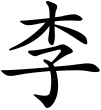
Lǐ
Clan Name
The surname comes first because the family is more important than the individual.
Given Name
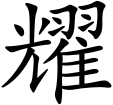
Yào
Generation Character
This character identifies the generation the individual belongs to.
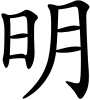
Míng
Personal Character
This character is the only part of the name that is unique to the individual.
If you're researching your ancestor Li Yaoming (李耀明), the middle character Yao (耀) may suggest they belong to the same clan and generation as Li Yaoguang (李耀光) and Li Yaoqiang (李耀强) from a neighboring village, because they share a common surname and generation character.
In Chinese naming, given names aren't common names like David or Mary; instead, they reflect qualities parents hoped their children would embody, such as intelligence, strength, or virtue.
What About Women?
While some clans used generation characters for women's names, most did not. Chinese women traditionally retained their surname after marriage, and wives were often recorded in clan records (when they were recorded at all) only by their surname. Even in immigration records or other documents, wives were often recorded only with their surname, as in Ms. Lee, Ms. Wong, or Ms. Lau. The Cantonese transliteration of the Chinese character for "Ms"—Shi (氏)—is "Shee," which beginning genealogists sometimes confuse for an actual name.
| Surname | Share of the population |
|---|---|
| Wang (王) | 7.38% |
| Li (李) | 7.3% |
| Zhang (張/张) | 6.97% |
| Liu (劉/刘) | 5.26% |
| Chen (陳/陈) | 4.59% |
| Yang (楊/杨) | 3.38% |
| Huang (黃/黄) | 2.52% |
| Zhao (趙/赵) | 2.11% |
| Wu (吳/吴) | 2.08% |
| Zhou (周) | 2% |
| Other Chinese Surnames | 59.39% |
Fun FactPrevalence of Common Surnames
If you meet someone Chinese, there is a good chance that person's surname is Li (李), Wang (王), or Zhang (張/张). That's because more than 22 percent of Chinese people have these surnames.
Although over 2,000 Chinese surnames are currently in use, the top 100 surnames account for about 86 percent of the Chinese population. Contrast that number with the United States, where the top 100 surnames represent only 14 percent of the population.
Why Do I Need to Know the Character for My Surname?
Finding the character for your surname is essential for tracing your roots. Without it, you don't truly know your surname. The same character can have different pronunciations across dialects such as Mandarin, Cantonese, and others, leading to various spellings. For example, the surname "Wong" could be 王, 黃, or 汪, and "Chin" might be 陳, 錢, or 秦.
YANG
YEUNG
YOUNG
Immigration officers often spelled names phonetically, leading to variations such as the surname 楊 (Yang in Mandarin, Yeung in Cantonese) becoming "Young." Surnames such as 熊, 容, and 翁 also sound similar, causing confusion. Without knowing your surname's character, you might mistakenly think you're related to all the "Youngs."
Knowing your surname can help identify your ancestral village. Traditionally, villages were made up of 1 or 2 families. For example, if your family is from Tongmay Village in Toisan, you might find multiple villages with similar names. But knowing your surname is Yip (葉) can help you pinpoint the correct village.
How Do I Find My Chinese Surname?
Chinese Surname Finder
Here is a tool to help you find your surname character.
Strategies for finding the Chinese character for your surname
Why Do My Ancestors Have So Many Names?
In ancient China, people often used many names throughout their lifetime. Read each of the cards below to learn about some of the alternate names your ancestors might have had.
(Zhi)
Courtesy or Style Name
In traditional society, it was considered disrespectful to call an adult male of the same generation by his given name, so males were given a courtesy name, or style name, upon becoming an adult. In some cases, women were also given a courtesy name at marriage, although this was less common. As a result, the given name was only used by one's elders, while the courtesy name was used more widely in public. The choice of a courtesy name generally reflected the values the parents wished for their son. Many families chose a generation character as part of the courtesy name so brothers and male cousins would have a common character in their courtesy names to identify them as family members.
(Hao)
Art Name, or Sobriquet
An art name, or sobriquet, was originally a pen name or professional name but later evolved into an alternate name selected to mark a significant life event, such as marriage. Unlike the courtesy name, the art name was chosen by the individual. In southeastern China (particularly in the Pearl River Delta), the art name is sometimes referred to as a "marriage name". Art names often contain a reference to the person's place of origin or characteristics of the person's residence.
(Hui)
Taboo Name
The definition of a taboo name differs from clan to clan and across different regions of China. At its most basic meaning, however, a taboo name suggests that this name is unique and is not the same as any of the person's ancestors. In some cases, people were forced to change their names to avoid having the same given name as an emperor. The key to understanding the taboo name is to talk to members of your clan who may know how it was used in your family.
(Shi)
Posthumous Name
A posthumous name, as you might guess, is a name given to a person after death. If all you know is your ancestor's posthumous name, it may be challenging to link your ancestor to other family records. A jiapu is typically the key to understanding the many names your ancestors may have had during—and after—their life.
Pro TipEntering Names in Family Tree
Always use Chinese characters when entering the names of your ancestors into Family Tree if possible.
FamilySearch automatically Romanizes characters for you. To include a different spelling, add it as an Alternate Name. Using Chinese characters as the primary name improves record accuracy. Beginners often regret using Romanized names, so avoid this mistake.