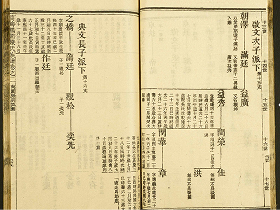
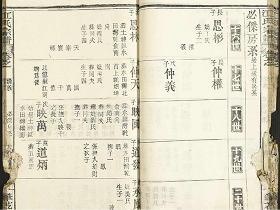
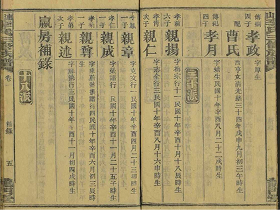
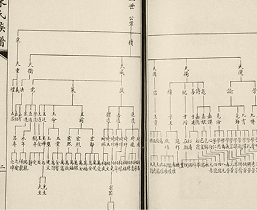
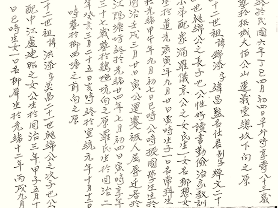
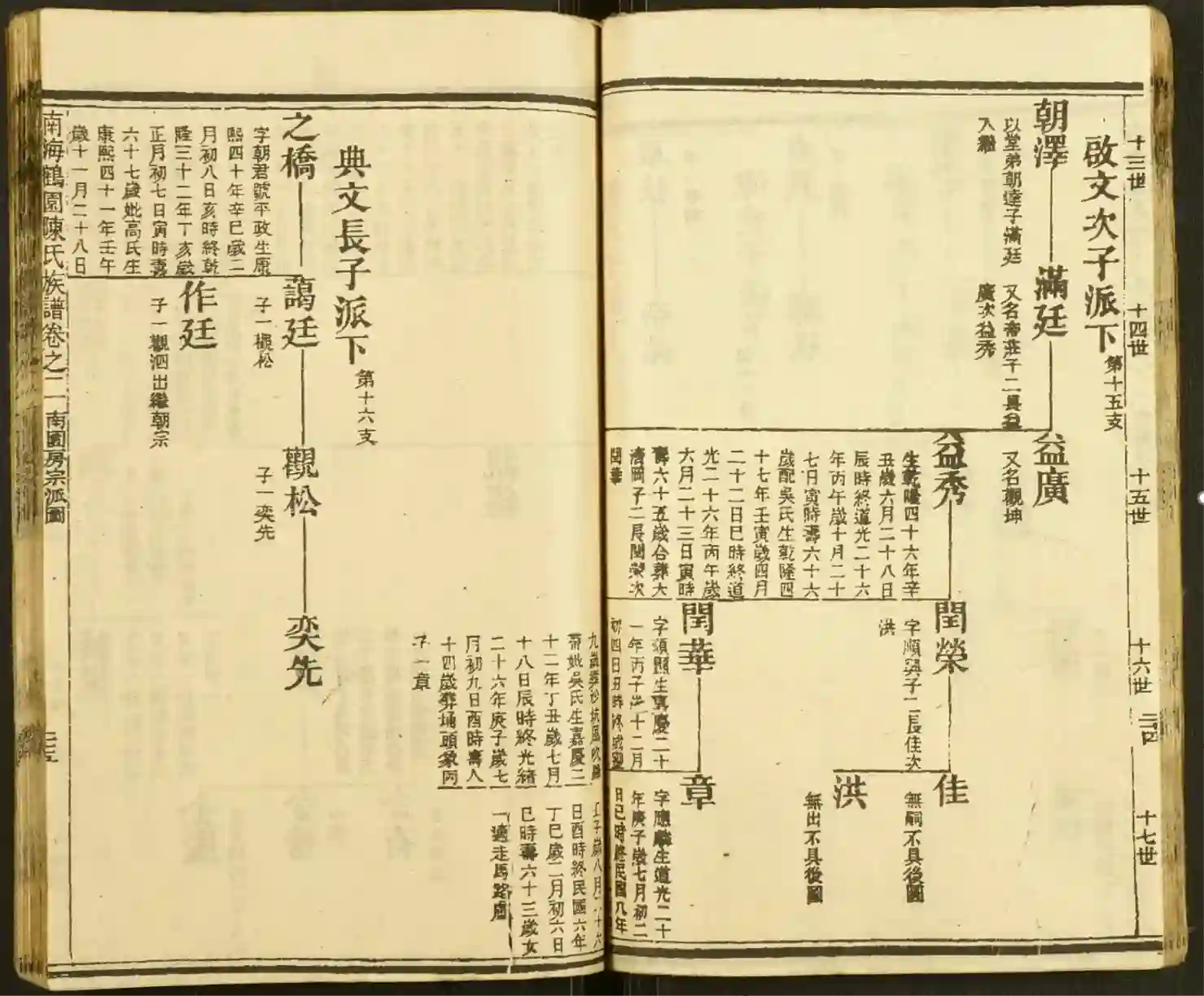
A jiapu, also called a zupu, is a traditional book that records family lineages. It preserves the family's bloodline heritage, often tracing back hundreds of years of history, usually focusing on male descendants, and serves as an important basis for studying family history.
Understanding Your Jiapu
Jiapu Guide
Your jiapu holds generations of your family's story. The Jiapu Guide helps you read and understand each part—even if you don't know Chinese.
A jiapu is not just a family tree—it records one clan's generational heritage, starting from the founding ancestor and continuing generation by generation.
Top-down arrangement: Starting from the founding ancestor, recording male descendants generation by generation.
Different recording methods for women: Wives are usually recorded only by surname, and daughters are rarely included.
Clan-centered: Focuses on presenting the history of a single family, different from Western family trees that often record the marital relationships of multiple families.
A jiapu is more than just a record of names. Its purpose is to preserve the identity and unity of the clan across generations. Many include not only charts of descendants but also biographies, migration histories, ancestral portraits, cemetery maps, family rules and teachings, generation poems that determined naming conventions, and detailed accounts of significant family events that shaped the clan's identity over centuries.
What's Inside a Jiapu?
Every jiapu is different, but most combine history, traditions, and detailed records. The following lists common contents, divided into three main categories:
Introductions and Origins
Preface
Surname Origins
Migration History
Examples
Table of Contents
Ancestral and Family Details
Ancestral Portraits
Cemetery Maps
Ancestral Hall
Family Rules
Family Teachings
Records and Charts
Pedigree Chart
Biographical Table
Biographies
Generation Poem
Postscript
How Do I Find My Jiapu?
A jiapu is not just a family tree—it records one clan's generational heritage, starting from the founding ancestor and continuing generation by generation.
Ask relatives – Talk to parents, grandparents, and elderly relatives. They may have a jiapu themselves or know someone else who has one.
Visit your ancestral village – Local elders, ancestral halls, or clan associations are often the most reliable sources for finding a jiapu.
You can use the Jiapu Guide to identify names, villages, and generations and other key information. After confirming your ancestors' identities, add them to the FamilySearch Family Tree to preserve this information and continue building your family tree.
Even if someone says your family's jiapu has been lost, there may still be hope. Many copies are often preserved through distant relatives, or through clan members who emigrated overseas before the 1960s. Some or even complete jiapu can still be found in places like Malaysia, Singapore, or the United States today. Keep searching—you may be surprised to discover that your family records still exist.
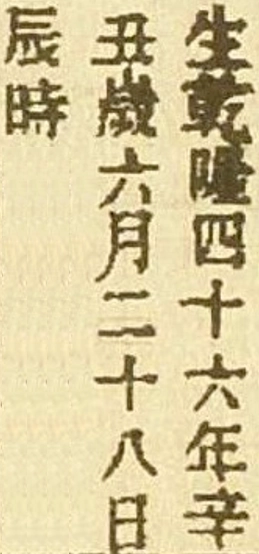
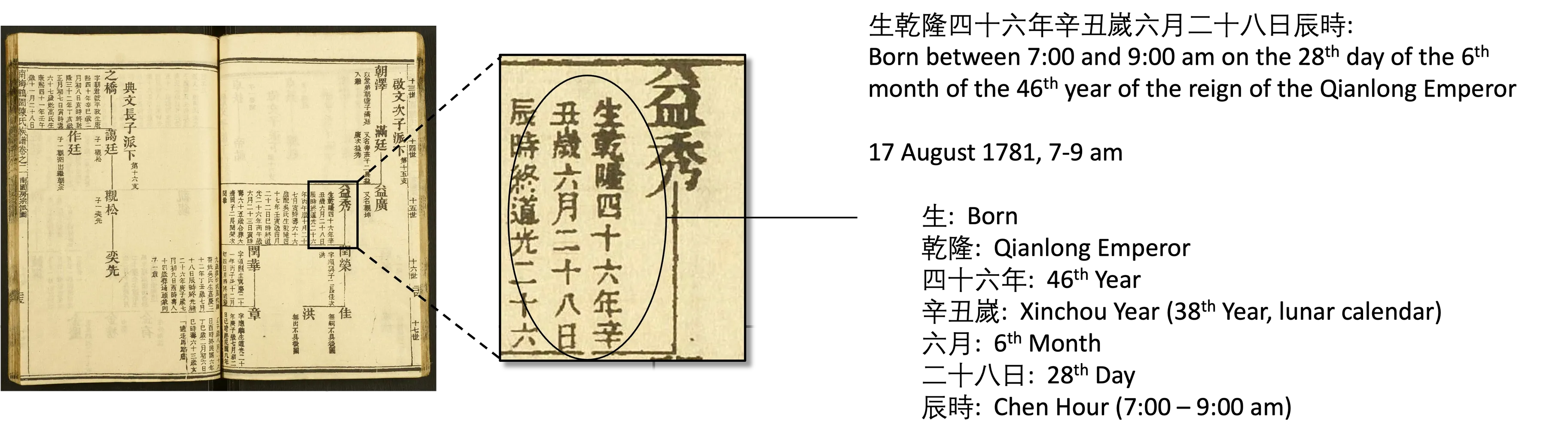
Born between 7:00 and 9:00 a.m. on the 28th day of the 6th month of the 46th year of the reign of the Qianlong Emperor
The date of birth is generally the first piece of information provided after the given name and any alternate names. The date of birth is easy to find since it is almost always preceded by 生於 (born on) or生 (born). Because classical Chinese usually has no punctuation, however, it can be a little harder to find where the date ends. Look for 日 (day) or 時 (hour) to know where the date ends.
The date of birth is generally the first piece of information provided after the given name and any alternate names. The date of birth is easy to find since it is almost always preceded by 生於 (born on) or 生 (born). Because classical Chinese usually has no punctuation, however, it can be a little harder to find where the date ends. Look for 日 (day) or 時 (hour) to know where the date ends.
Chinese dates—both ancient and modern—are written "large to small." That is, they begin with the largest measure of time and proceed to increasingly smaller units of time.
Ancient dates generally begin with the dynasty (sometimes omitted), followed by the reign title of the emperor, the lunar date (year, month, and day), and the hour of the day.
If you are entering the date into FamilySearch, you can simply type the characters as they appear in a jiapu and the system will automatically convert the date string into a modern Gregorian (Western) date.
You can also use our Calendar Converter to convert the date to a Gregorian date.
Ancient Dates
Dynasty
Usually, the first character after 生於 (born on) or 生 (born) is the name of the dynasty. In this example, however, the dynasty is omitted. Since we see that the emperor was Qianlong (refer to the and ), we know that this was during the Qing Dynasty. This would appear as 清 (Qing), 大清 (Great Qing), 清朝 (Qing Dynasty), or 清代 (Qing Dynasty), though any of these variations would usually just be translated as "during the Qing Dynasty".
Refer to the table for a more-or-less complete list of dynasties.
One quick note about spellings—dynasty names in English used to be spelled using the Wade-Giles Romanization system. For example, the Qing Dynasty was written as the Ch'ing Dynasty (or less correctly as the Ching Dynasty). It is important to understand that the names in Chinese never changed; only the English spellings changed. Scholarly journals from thirty or more years ago uniformly used Wade-Giles to Romanize Chinese, but now they just as uniformly use Hanyu Pinyin. Even if you are more familiar (or comfortable) with Wade-Giles, you should use the Hanyu Pinyin spellings in your translations (if you are using a Romanization for your translation).
Reign Title
When an emperor ascended the throne, he assumed a reign title. Years are recorded as "the such-and-such year of the so-and-so emperor" as in this example, which is "the 46th year of the Qianlong Emperor".
Consult the table for a list of the emperors' reign titles.
Lunar Date
Although converting lunar dates to Gregorian dates can be tedious, it should not be difficult to find the year, month, day, and possibly hour.
年
Find the character 年 to identify the year. The number of the year precedes 年, so in this example we see 四十六年, which means 46th year.
月
Find the character 月 for the month. Again, the number precedes 月. In this example, we see 六月 or "sixth month". Please note that this is the 6th lunar month, not the month of June.
日
Find the character 日 for the day. Since the number precedes 日, here we have the 28th day (二十八日) of the month.
時
Look for the character 時 for the hour of the day. In ancient China there were 12 hours in a day, not 24. As a result, each Chinese hour is two hours long by modern reckoning. See the table for their modern equivalents.
Gregorian Date
When you enter the date into FamilySearch's Family Tree, the system will automatically convert the date for you.
Date
乾隆四十六年辛丑嵗六月二十八日辰時
Lunar Date
Between 7:00 and 9:00 am on the 28th day of the 6th month of the 46th year of the reign of the Qianlong Emperor
Gregorian Date
17 August 1781, 7-9 am
Modern Dates
Republic of China Date
The Republic of China, which was founded on January 1, 1912, instituted a new calendar that adopted part of the traditional calendar system, but not all. In place of a "dynasty", they substituted the Republic of China Era (民國時期). But since there were no emperors, the calendar did not re-start every time a new president was elected. As a result, the Republic of China Calendar began with 1912 as the "First year of the Republic of China" and continued adding a year every year thereafter. This calendar system ended in 1949 when the People's Republic of China was founded, though many jiapu in Taiwan continue to use the Republic of China Calendar.
If you see 民國 (Republic of China) before the year, just translate it as "such-and-such year of the Republic of China". For example, if you see 民國八年 it should be translated "the 8th year of the Republic of China."
Converting Republic of China dates to Gregorian dates is easy—just add 1911 to the date shown in the jiapu. So in the example 民國八年 you add 8 and 1911 to get the Gregorian date of 1919.
Date
民國八年
Gregorian Date
1919
Common Era Date
The Common Era refers to the dating system familiar to many people as the Christian Era. Hence, BCE (Before the Common Era) corresponds to BC (Before Christ), and CE (Common Era) corresponds to AD (Anno Domini).
In Chinese jiapu, a modern date is sometimes preceded by 公曆 or 陽曆 to indicate that the Common Era is being used.
Common Era dates are composed of the year, month, and day (hour of the day is generally omitted). There is no need to convert Common Era dates.