Skip to Main Content
FamilySearch
  • Overview
  • Tree
  • Find
  • Following
  • My Contributions
  • Person List
  • Records
  • Full Text
  • Images
  • Family Tree
  • Genealogies
  • Catalog
  • Books
  • Research Wiki
  • Cemeteries
  • Newspapers
  • Overview
  • Gallery
  • Family Feed
  • Overview
  • Opportunities
  • Your Impact
  • What is Indexing
  • All Activities
  • Together App
  • Where Am I from?
  • Surname Origins
  • All About Me
  • Famous Relatives
  • Compare-a-Face
  • Record My Story
  • Picture My Heritage
  • Search Articles
  • Help and Learning
  • Getting Started
  • Community
  • Helpful Resources
  • Contact Us
Sign Up
Explore More Topics

What is a Clan Genealogy Book?

Explore the Jiapu Guide
  • Facebook
  • Messenger
  • X
  • WhatsApp
  • Email
  • Copy Link

Jiapu

A jiapu, also called a zupu, is a traditional book that records family lineages. It preserves the family's bloodline heritage, often tracing back hundreds of years of history, usually focusing on male descendants, and serves as an important basis for studying family history.

Understanding Your Jiapu

Jiapu Guide

Your jiapu holds generations of your family's story. The Jiapu Guide helps you read and understand each part—even if you don't know Chinese.

Explore Guide

Common Jiapu Styles

Start exploring the common styles below. Click a style to see how it's structured inside the guide.
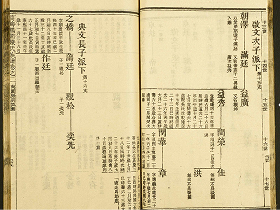
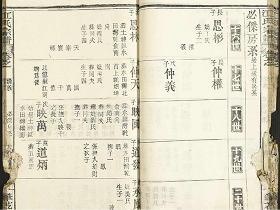
Su Style (蘇式)

Hanging Pearl Style (垂珠體)

Ou Yang Style (歐陽式)

Horizontal Style (橫行體)

Imperial Style (牒記式)
Pagoda Style (寶塔式)
Document Style (文檔式)

Story Line Style (流水式)

What Makes a Jiapu Unique?

A jiapu is not just a family tree—it records one clan's generational heritage, starting from the founding ancestor and continuing generation by generation.

  • Top-down arrangement: Starting from the founding ancestor, recording male descendants generation by generation.
  • Different recording methods for women: Wives are usually recorded only by surname, and daughters are rarely included.
  • Clan-centered: Focuses on presenting the history of a single family, different from Western family trees that often record the marital relationships of multiple families.

A jiapu is more than just a record of names. Its purpose is to preserve the identity and unity of the clan across generations. Many include not only charts of descendants but also biographies, migration histories, ancestral portraits, cemetery maps, family rules and teachings, generation poems that determined naming conventions, and detailed accounts of significant family events that shaped the clan's identity over centuries.

What's Inside a Jiapu?

Every jiapu is different, but most combine history, traditions, and detailed records. The following lists common contents, divided into three main categories:

Introductions and Origins

  • Preface
  • Surname Origins
  • Migration History
  • Examples
  • Table of Contents

Ancestral and Family Details

  • Ancestral Portraits
  • Cemetery Maps
  • Ancestral Hall

  • Family Rules
  • Family Teachings

Records and Charts

  • Pedigree Chart
  • Biographical Table
  • Biographies
  • Generation Poem

  • Postscript

How Do I Find My Jiapu?

A jiapu is not just a family tree—it records one clan's generational heritage, starting from the founding ancestor and continuing generation by generation.

  • Ask relatives – Talk to parents, grandparents, and elderly relatives. They may have a jiapu themselves or know someone else who has one.

  • Visit your ancestral village – Local elders, ancestral halls, or clan associations are often the most reliable sources for finding a jiapu.

    Learn More
  • Search online – The most convenient way is through large databases. You can use the following links to search the three largest collections:

    Jiapu Search
    Shanghai Library

I Found My Jiapu—Now What?

You can use the Jiapu Guide to identify names, villages, and generations and other key information. After confirming your ancestors' identities, add them to the FamilySearch Family Tree to preserve this information and continue building your family tree.

Family Tree

RememberDon't Give Up!

Even if someone says your family's jiapu has been lost, there may still be hope. Many copies are often preserved through distant relatives, or through clan members who emigrated overseas before the 1960s. Some or even complete jiapu can still be found in places like Malaysia, Singapore, or the United States today. Keep searching—you may be surprised to discover that your family records still exist.
About
  • Our Story
  • Newsroom
Ways to Contribute
  • Get Involved
  • What is Indexing
  • Volunteer
  • Donate
  • FamilySearch Labs
For Church Members
  • Ordinances Ready
  • Family Name Assist
  • Leadership Resources
  • Temple and Family History Consultant Training
FamilySearch Apps
  • Family Tree Apps
  • Memories App
  • Get Involved App
  • Together App
  • All Mobile Apps
Genealogy Resources
  • Obituaries
  • Cemeteries
  • FamilySearch Catalog
  • Ancestor Search
  • Genealogy Search
  • Place Names
  • Guided Research
  • Digital Books
Get Help
  • User Community
  • Help Center
  • Contact Us
  • Your Account
  • Suggest an Idea
Industry
  • Archives
  • Developer Center
  • Solutions Gallery
Guidance and Learning
  • Getting Started
  • RootsTech Conference
  • What's New
  • Learning Center
  • Genealogy Research Wiki
  • YouTube Channel
  • Free Virtual Consultations
  • Blog
Locations
  • Salt Lake FamilySearch Library
  • Find a Local FamilySearch Center
  • FamilySearch Affiliates
What We Offer
  • Family Tree
  • Genealogy Records
  • Family Photo Sharing
  • Family Activities
  • Learning Resources
  • Research Guidance
  • DNA Education
  • Surname Meanings
Third-Party Access
  • Ancestry
  • MyHeritage
  • FindMyPast
  • American Ancestors
  • Geneanet
  • Storied
  • All Third-Parties
FamilySearch

Inspiring people everywhere to connect with their family—across generations.
FamilySearch is an international nonprofit organization. Donate or volunteer today!

Accessibility Support
FamilySearch Legal Center | FamilySearch Terms of Use | FamilySearch Privacy Notice |  | Site Map | Country and Language Options
© 2026 by Intellectual Reserve, Inc. All rights reserved. A service provided by The Church of Jesus Christ of Latter-day Saints.
A service provided by The Church of Jesus Christ of Latter-day Saints.

Jiapu Guide

Su Style (蘇式)Ouyang Style (歐式)Imperial Style (牒記式)Pagoda Style (寶塔式)Document Style
1234567891011121314
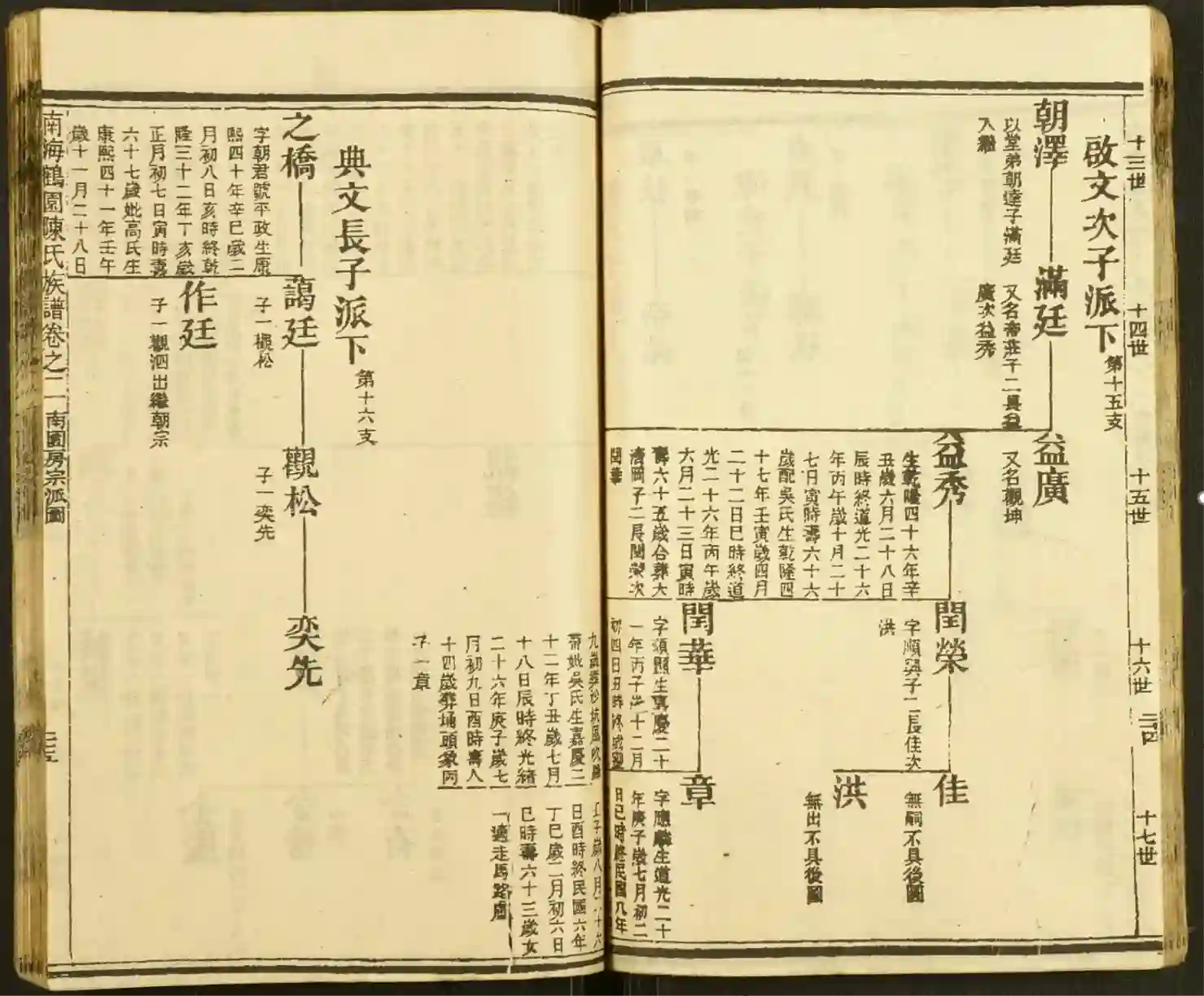
Su Style Jiapu

Place of Birth

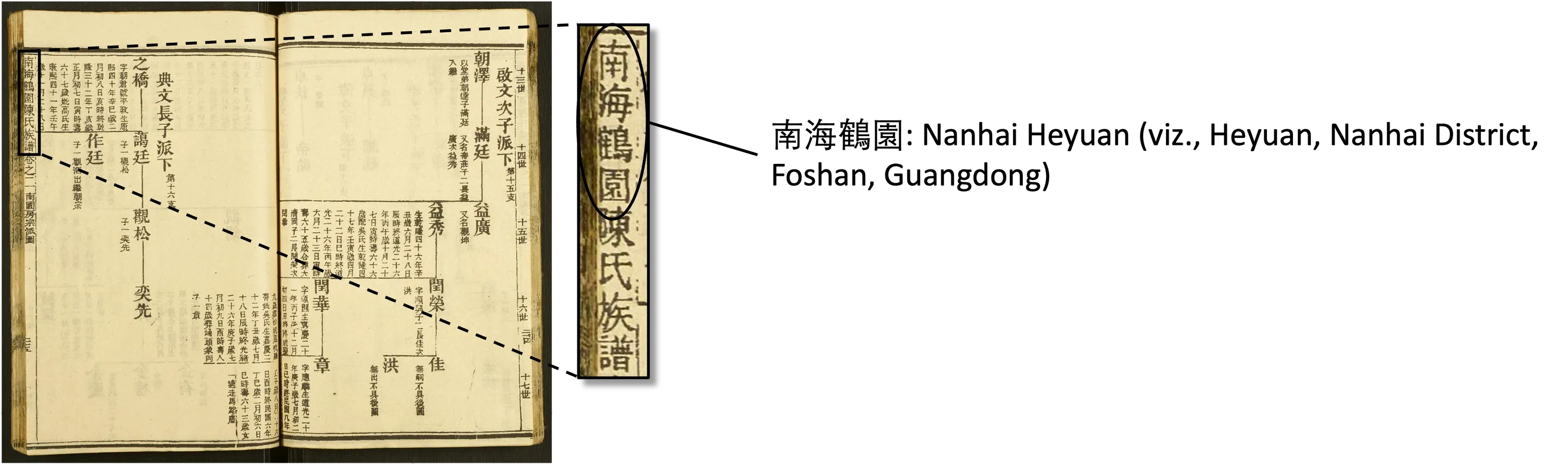
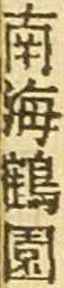
南海鶴園

Nanhai Heyuan

The place of birth is generally assumed from context. For most people in the jiapu the place of birth will be the same as the place recorded in the title of the jiapu. In this example—as in most jiapu—the title of the jiapu can be found on the edge of the page, with the place preceding the surname. Since Chinese place names are written "large to small", the county name in this example precedes the village name.

Learn More

Jiapu Legend

  • Intro: Su Style (蘇式)
  • 1.  Surname
  • 2.  Given Name
  • 3.  Generation
  • 4.  Date of Birth
  • 5.  Place of BirthOpen
  • 6.  Date of Death
  • 7.  Place of Death
  • 8.  Age at Death
  • 9.  Spouse's Surname
  • 10.  Spouse's Date of Birth
  • 11.  Spouse's Date of Death
  • 12.  Spouse's Age at Death
  • 13.  Place of Burial
  • 14.  Number of Sons

Place of Birth

Place of Birth Details

The place of birth is generally assumed from context. For most people in the jiapu the place of birth will be the same as the place recorded in the title of the jiapu. In this example—as in most jiapu—the title of the jiapu can be found on the edge of the page, with the place preceding the surname. Since Chinese place names are written "large to small", the county name in this example precedes the village name.

If your jiapu has a short title like "Chen Family Jiapu", the title on the edge of the page won't be much help. In that case, you will have to flip to the front of the book and look at the cover or the title page, which will generally have the short title (Chen Family Jiapu) in big letters, followed or preceded by the place in smaller letters.

Most jiapu contain records for all family members in a single location, hence the assumption that everyone in the book was born and died in the same place. But a jiapu frequently begins with the first ancestor who moved to that location. As a result, it is common for the first ancestor (or first few ancestors) to have been born somewhere else before moving to the main location of the jiapu. You will have to check the biographical entry for the first ancestor or read the preface carefully to find this information. This will be challenging if you don't read Chinese, so you may have to ask someone to help you read or translate the first ancestor's biographical entry or the preface.

For a large, multi-volume jiapu, members of the family may have settled in many different places. In this case, the jiapu is generally divided into branches, with each branch representing a place where members of the clan settled. The place of birth would be the place mentioned in the branch name, which may be found on the edge of the page or on the page where that branch begins.

If you are entering the Place of Birth into Family Tree, the system will require that you select a "standardized location", which generally only goes down to the city or county level. In this example, you would have to select "Nanhai, Foshan, Guangdong, China".

Place of Birth

Heyuan, Nanhai District, Foshan, Guangdong

How do you figure out where the place is if you don't read Chinese?

This can be a bit challenging, but here are some tips.

  Look for the characters for province, city, county, village, etc.

Jiapu frequently omit the Chinese characters for province, city, county, etc., but when you do find these characters your job just got a whole lot easier. If your jiapu does have these characters, they are probably not going to be located in the title that you see on the edge of the page, but rather on the cover page or title page. Take a moment to look there and see if you can find any of the characters below:

English TranslationTraditionalSimplifiedMandarin (Pinyin)Cantonese (Jyutping)
Province省省ShěngSaang2
City市市ShìSi5
District區区QūAu1
County縣县XiànJyun2
Town鎮镇ZhènZan3
Village村村CūnCyun1
Township鄉乡XiāngHoeng1
Neighborhood里里LǐLei5
Hamlet鄰邻LínLeon4
Start with the largest place name.

It is easier to find the place you are looking for if you start searching for the bigger place (province, city, or county) and then search for the smaller place (town, village, township). In this example, we see four characters, consisting of two place names. You can guess this because most place names consist of two characters (not including the characters for city, county, etc.). So, in this example, you start by searching for 南海 and don't worry about searching for 鶴園 until later.

Google Maps is your friend.

Begin your search in Google Maps. Google Maps is helpful because it gives you a lot of information in English and because it helps you find modern equivalents if the place name has changed a bit over time. It also gives you a map so you can see the place you are looking for. In this example, 南海 pulls up a map of the South China Sea, since 南海 can mean "South Sea." Since you can assume that your ancestor was not born in the middle of the ocean, you should read the next tip.

Guess "city" or "county" if your jiapu doesn't provide that information.

There is a good chance that the largest place name is a city or county, assuming that it is not a province. You may want to check the list of first, just to make sure the place you are looking for isn't a province. In this example, searching by either 南海市 or 南海縣 in Google Maps gives you the same result—Nanhai District, Foshan, Guangdong.

Wikipedia is also your friend.

Once you find Nanhai District on Google Maps you will see a link to the Wikipedia article about the place that provides a history of the area and other useful information. And—lucky for you—it's in English.

Small places are hard to find.

This tip may not seem helpful at first, but with some experience you will find that it is true and that it helps relieve a lot of stress and saves you a lot of time searching for something that will not matter much in the end. In this example, 鶴園 is a neighborhood that does not appear on any list of recognized places in Nanhai District, though Google Maps will help you find a restaurant by that name, as well as a nearby street with 鶴園 in the name.

Previous: Date of Birth
Next: Date of Death